How implant placement shapes your final result
Implant placement is more than a technical detail, it’s a key factor in how your results look, feel, and settle over time. The same implant can create very different outcomes depending on where it sits relative to your breast tissue and muscle.
Understanding the main placement options and how each approach influences appearance, softness, and recovery can help you approach your consultation with clearer expectations and more informed questions.
In this article:
- Implant placement options: An overview of the main approaches (over the muscle, under the muscle, and dual-plane) and when each may be considered.
- How implant placement affects appearance: How placement influences upper pole fullness, edge visibility, cleavage, and overall breast shape.
- How implant placement affects recovery: What to expect in terms of early tightness, movement, and how placement can influence your return to normal activity.
- Visit Our Gallery: See real patient results across different placement approaches to understand how choices translate in practice.
A more complete look at your options
This page focuses on breast implant placement options. If you’d like a deeper look at procedures, outcomes, and how each approach compares, explore the full breast augmentation guide.
Implant placement options
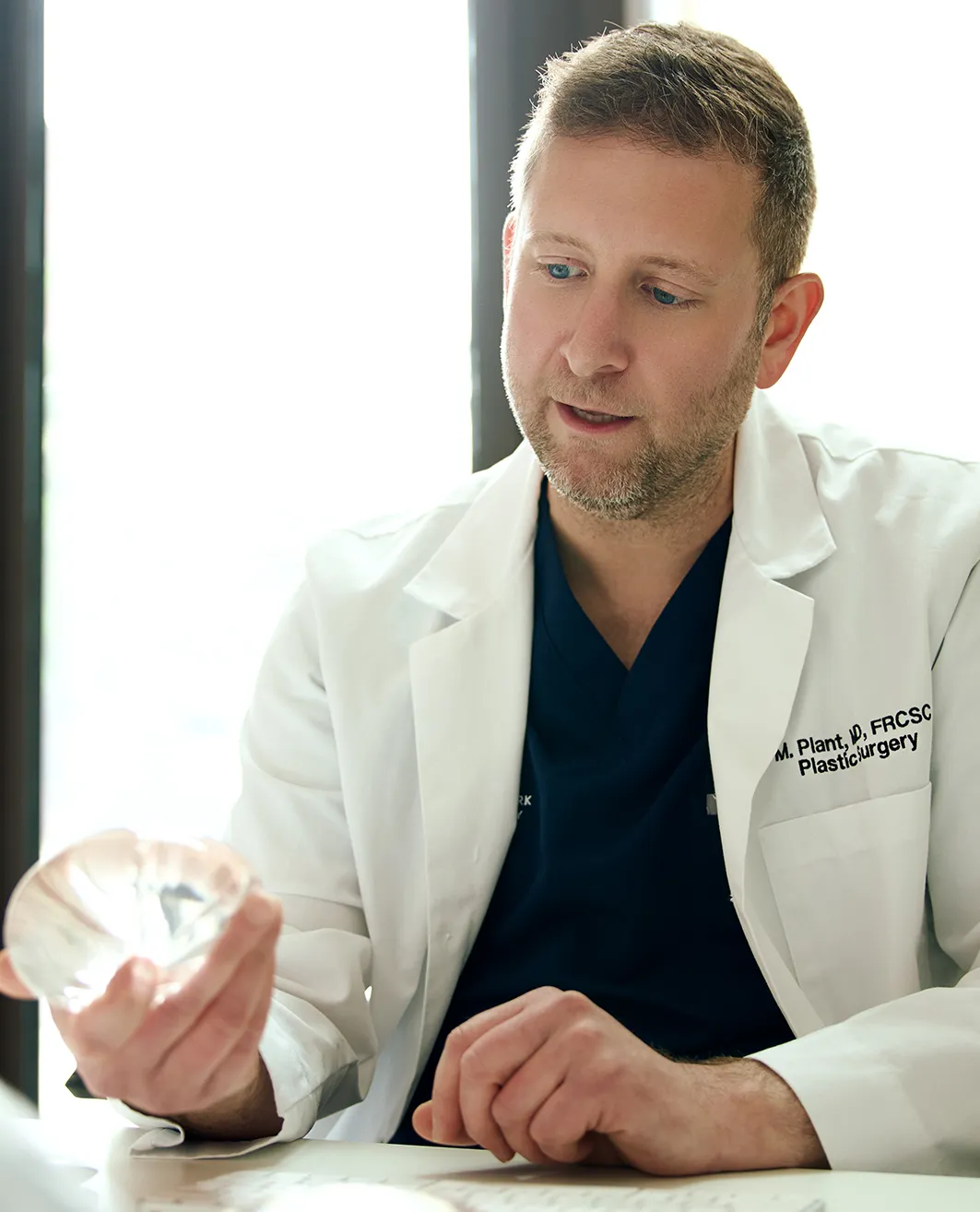
In breast augmentation, your surgeon creates a pocket behind the breast tissue to hold the implant. That pocket can sit over the muscle, under the muscle, or as a combination approach.
Each option influences how the implant is supported, how visible its edges may be, and how the breast moves over time. The right choice depends on your anatomy, tissue thickness, and the look you’re trying to achieve, not just preference.
1. Subglandular breast implant placement
Subglandular placement positions the implant behind the breast gland and on top of the chest muscle. This approach can create a more immediate increase in projection and may help elevate the nipple position in select patients.
It is often considered when there is enough natural tissue to cover the implant. In thinner patients, this approach can increase the likelihood of visible implant edges or rippling, particularly along the sides or upper portion of the breast.
When used appropriately, subglandular placement can support a more pronounced shape with less interaction from the chest muscle during movement.
2. Submuscular breast implant placement
Submuscular placement positions the implant under the pectoral muscle, adding an additional layer of coverage over the upper portion of the implant. This can help reduce edge visibility and improve camouflage in patients with less natural tissue.
Muscle coverage can also contribute to a softer transition in the upper breast, particularly when aiming for a more gradual slope rather than a sharply defined upper pole.
A fully submuscular pocket is used less commonly in modern aesthetic breast surgery, as it can increase the risk of implants sitting higher on the chest. Instead, variations that balance coverage and shape are more often considered.
3. Dual-plane breast implant placement
Dual-plane placement is a hybrid technique and is commonly used in modern breast augmentation. The upper portion of the implant is covered by muscle to help minimize edge visibility, while the lower portion sits beneath the gland to allow for natural lower pole expansion.
This approach can support a softer upper contour while still achieving fullness where it is most noticeable. It is particularly useful when there is mild to moderate tissue laxity or when subtle nipple elevation is desired without a formal lift.
Variations of this technique (Dual Plane I–III) allow the approach to be adjusted based on anatomy, helping balance coverage, shape, and position in a more tailored way.
In practice, placement is not about choosing a single “best” option—it’s about selecting the approach that works with your anatomy to support the result you’re aiming for, both immediately and over time.
Implant placement comparison
| Placement | Best suited for | Key advantages | Trade-offs to consider |
|---|---|---|---|
| Subglandular (over the muscle) | Patients with adequate natural tissue coverage and a desire for more projection | Stronger projection, less animation with muscle movement, may help with mild nipple elevation | Higher chance of visible edges or rippling in thinner patients; less upper-pole coverage |
| Submuscular (under the muscle) | Patients with thinner tissue who benefit from added coverage | Improved edge camouflage, softer upper contour, reduced visibility in the upper breast | Can feel tighter initially; implants may sit higher early on; some movement with muscle contraction |
| Dual-plane (hybrid) | Most patients seeking a balance of coverage and natural shape | Combines upper-pole coverage with lower-pole fullness; adaptable to different anatomies | Slightly more complex technique; recovery may include some early tightness from muscle involvement |
How implant placement affects appearance
Implant placement plays a key role in how your results look at rest, in motion, and in clothing. The same implant can create very different outcomes depending on how it is supported by your tissue and muscle.
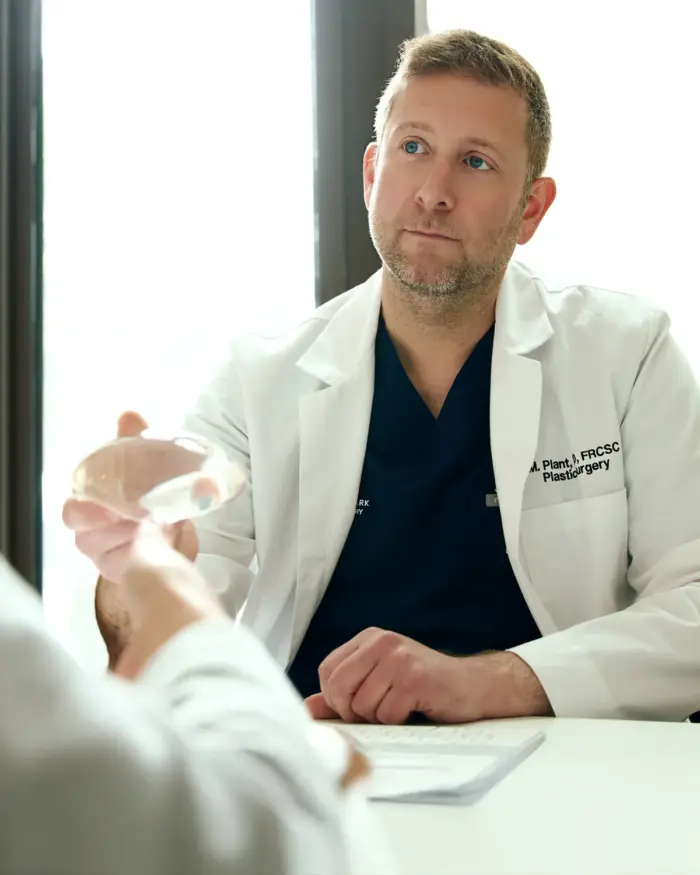
During consultation, Dr. Plant will assess your tissue coverage and goals to recommend an approach that supports the shape you want while maintaining a natural transition and long-term balance.
Upper pole fullness and edge visibility
Implant placement has a direct impact on how full the upper portion of the breast appears. Over-muscle placement can create a more defined upper pole in some patients, particularly when combined with higher projection implants.
However, when tissue coverage is thin, this approach can increase the likelihood of visible implant edges or rippling, especially along the upper and outer breast.
Under-muscle or dual-plane placement adds an extra layer of coverage over the upper portion of the implant, which can help soften the transition from chest to breast and reduce visible edges. This is often preferred when aiming for a more gradual slope or when natural tissue is limited.
Cleavage and breast shape
Cleavage and overall breast shape are influenced by several factors working together, including base width, implant profile, tissue characteristics, and placement. Placement helps determine how volume is distributed and how the breast transitions across the chest.
Dual-plane placement can support a softer upper contour with fullness in the lower breast, creating a more natural slope in many patients. Over-muscle placement may be selected when stronger projection or subtle nipple elevation is a priority, provided there is enough tissue to support the implant.
Rather than creating cleavage on its own, implant placement works within your existing anatomy. The goal is to enhance shape and proportion while maintaining a result that looks balanced from multiple angles.
These differences are often subtle, but they play a significant role in whether a result looks more augmented or more naturally integrated with your body.
How implant placement affects recovery
Recovery varies by individual and surgical plan, but implant placement can influence how your chest feels in the early weeks after surgery. The involvement of the chest muscle—particularly in under-muscle or dual-plane approaches—can affect tightness, movement, and how quickly you feel “back to normal.”
Your surgeon’s guidance should always direct activity and progression, but understanding these differences can help set clearer expectations.
Chest tightness and movement
When the implant is placed under the muscle, early tightness across the chest is often more noticeable, and certain movements—especially pushing, lifting, or reaching—may feel more restricted at first. This is a normal response as the muscle adapts to the implant.
With over-muscle placement, there is typically less muscle-related tightness, and some patients find early movement feels more natural.
In both cases, swelling gradually improves and the chest becomes more comfortable as tissues settle over the first few weeks.
Return to exercise and workouts
Most patients begin with light activity such as walking, then gradually increase movement as they are cleared. Many people can return to desk work within about 1 to 2 weeks, depending on comfort and job demands.
When the muscle is involved, upper-body workouts may take longer to resume, as the chest needs time to recover from both surgery and muscle adjustment. Over-muscle placement may allow for a slightly quicker return to certain movements, but progression should always follow your surgeon’s recommendations.
If you want a clearer sense of how recovery often progresses week by week, breast augmentation recovery stages can be a helpful reference point.
When to contact your surgeon
Contact your clinic promptly if you experience:
- Fever, chills, or feeling unwell
- Increasing redness, warmth, swelling, or drainage from incisions
- Sudden worsening pain, especially on one side
- Shortness of breath or chest pain
- Rapid swelling, firmness, or a sudden change in breast shape
If something feels off, it is always appropriate to call.
Visit Our Gallery
If you’re trying to understand how placement and sizing choices translate in real results, browsing before-and-after photos can be a helpful starting point.
Look for patients with a similar body type and starting point, and focus on overall shape and proportion (not just size). Saving a few examples can help communicate your preferences more clearly during consultation.
Dr. Plant can then walk you through what would be required to achieve a similar look, and what is realistic based on your anatomy.
Prepare for your consultation with confidence
Want to make the most of your consultation with Dr. Plant? Download our plastic surgery consultation guide to help you organize your goals, understand your options, and come prepared with the right questions.