Your complete guide to breast augmentation surgery
Breast augmentation is a highly personalized procedure and remains one of the most commonly performed cosmetic surgeries worldwide 1. While many people think of it simply as “choosing a size,” the reality is a series of thoughtful decisions that work together to shape your final result. This guide is designed to walk you through those decisions, so you can understand your options, ask better questions, and feel confident heading into your consultation.
In this guide:
- Breast augmentation options: Explore the different approaches to breast augmentation, including implants, fat transfer, and hybrid techniques, and how each option shapes your results.
- Breast implant planning basics: Understand the key decisions involved in planning your procedure, from sizing and proportions to how your anatomy influences the outcome.
- Breast augmentation recovery overview: Learn what to expect after surgery, including downtime, healing milestones, and when you can return to daily activities.
- Breast Augmentation Consultation Checklist: Prepare for your consultation with a clear list of questions and considerations to help guide the conversation.
- Breast implant safety and long-term considerations: Get a balanced understanding of implant safety, longevity, and what to expect over time, including maintenance and monitoring.

Breast augmentation options
Breast augmentation can be approached in a few different ways. The best fit depends on your anatomy, your desired change in volume and shape, and how you want your results to look and feel over time. During consultation, Dr. Plant will help you compare options with safety, proportion, and long-term planning in mind.
1. Breast implant augmentation
Breast implant augmentation is a reliable way to add volume and reshape the breast. Implants can help improve overall fullness, enhance symmetry, and restore volume after pregnancy, breastfeeding, weight changes, or natural breast development.
Implant selection is based on measurements (like chest width and breast base width), soft tissue coverage, and skin elasticity. The goal is a result that suits your frame and aligns with your aesthetic preferences, whether you want a subtle enhancement or a more noticeable change.
2. Fat transfer breast augmentation
Fat transfer breast augmentation uses your own fat to create a softer, more subtle increase in volume. Fat is gently removed from a donor area (such as the abdomen, hips, or thighs), processed, then carefully placed into the breast.
This option may be a fit if you want modest volume, prefer to avoid implants, and have enough donor fat available. Not all transferred fat survives long term, so results can vary. In some cases, more than one session may be needed to reach your goal.
3. Hybrid breast augmentation with breast implants and fat transfer
Hybrid breast augmentation combines implants for structure and volume, plus fat transfer for refinement. This approach can help soften edges, improve contour transitions, and fine-tune shape, especially in patients with thinner tissue coverage or those seeking a very customized result.
Breast Augmentation Options at a Glance
| Option | Best For | Volume Increase | Look & Feel | Key Considerations |
|---|---|---|---|---|
| Breast Implants | Patients looking for a noticeable, predictable increase in size and shape | Moderate to significant | Natural but structured, with a wide range of profiles and projections | Long-term maintenance (implants may need to be replaced), choice of size/type is critical |
| Fat Transfer | Patients wanting a subtle, natural enhancement using their own tissue | Mild to moderate | Very natural look and feel | Requires sufficient donor fat; some fat does not survive, may need multiple sessions |
| Hybrid (Implants + Fat Transfer) | Patients seeking both volume and refined shaping, especially with thinner tissue | Moderate (with enhanced contouring) | Balanced—structured with softened edges | More complex procedure; combines considerations of both implants and fat transfer |
Breast Augmentation Candidacy
From anatomy to expectations, several factors shape the right approach. With studies showing patient satisfaction rates above 90% 2, the key is ensuring the procedure is right for you.
Breast implant planning basics
Implant planning is more than picking a cup size. It is a set of decisions that work together, including size, profile, placement, and implant type. A consultation should translate your goals into a plan that fits your anatomy and lifestyle.
Breast implant size and proportion
Implant “size” is often discussed in cc, but the most important factor is how that volume fits your body. Chest width, breast base width, skin elasticity, and tissue thickness all affect how an implant will look and feel.
Bring a few inspiration photos that reflect the look you like (not just a bra size). Dr. Plant can then guide you toward options that are realistic and proportional. Choosing the right size is one of the most important—and most misunderstood—parts of planning.
→ Read: Choosing the Right Breast Implant Size
Breast implant projection and profile
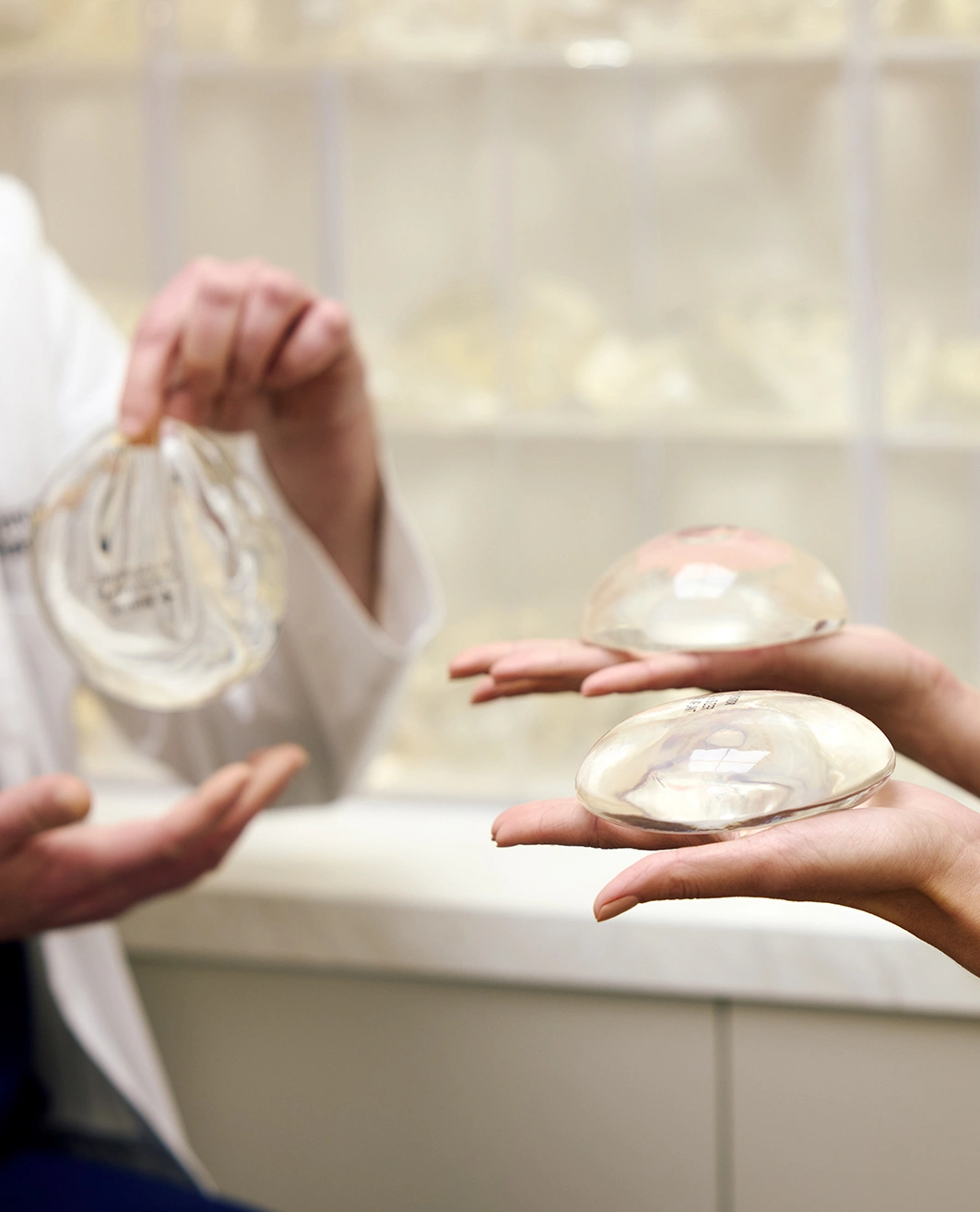
Projection (profile) refers to how far an implant projects forward relative to its base width. Two implants can have the same volume but create different silhouettes depending on profile and how they match your chest measurements.
Profile selection is a balance between your anatomy and your desired shape. Higher profile is not always the best choice, and more projection is not the same as “more natural.” The goal is a harmonious shape with appropriate soft tissue support.
Breast implant placement options
Implants can be placed in different pockets, and placement influences feel, movement, upper pole shape, and how visible the implant edges may be.
Common options include:
- Above the muscle (subglandular) in select patients with adequate tissue coverage
- Partial muscle coverage (dual-plane) or under the muscle (submuscular) when additional soft tissue coverage is beneficial
The right placement depends on your tissue characteristics, lifestyle, and goals, and should be decided with your surgeon. Placement plays a major role in how your results look and feel over time.
→ Read: Breast Implant Placement Options Explained
Breast Implant types
Breast implants are medical devices with different fill materials and design characteristics. Many patients compare saline versus silicone gel options, including more cohesive gels.
Rather than focusing on a single “best” type, it helps to discuss what matters most to you, including feel, shape, incision planning, and long-term monitoring preferences. Dr. Plant will review the trade-offs so you can choose confidently.
Implant type is often where patients start, but it’s best understood in the context of your full plan.
Planning for a natural-looking outcome
Many patients come in asking for a natural result—but that can mean different things depending on your anatomy, proportions, and goals. Understanding this early helps guide every decision, from size to placement.
→ Read: Natural-Looking Breast Augmentation: What That Actually Means

Breast augmentation recovery overview
Recovery is a gradual process that unfolds over several weeks. While many patients feel well enough to resume light daily activities within a few days 3, your body continues to heal and settle over time. Understanding what to expect at each stage helps you plan ahead and feel more confident throughout your recovery.
Recovery happens in phases, with different milestones along the way.
→ Read: Breast Augmentation Recovery Stages: What to Expect Week by Week
Early recovery and discomfort
In the first several days, tightness, pressure, swelling, and soreness are common. If muscle is involved, the chest may feel especially tight with movement. Discomfort is typically most noticeable early, then gradually improves.
Gentle walking, rest, hydration, and following your medication plan can help support early recovery. Your clinic will also give you specific instructions for incision care and activity restrictions.
Return to work and exercise
Many patients return to non-physical work within about 1 to 2 weeks, depending on their comfort and job demands. Exercise is usually reintroduced gradually, starting with walking and progressing only when you are cleared.
Heavier lifting and upper-body workouts typically require a longer pause. Your timeline should be personalized to your procedure plan and healing.
Long-term settling and scars
It is normal for implants to sit higher early on. As swelling decreases and tissues relax, the breasts typically settle over weeks to months. Final shape can take time.
Scars also evolve. They often appear more noticeable early, then fade gradually over months. Scar appearance varies by incision placement, skin type, healing tendencies, and aftercare.
Wearing a surgical bra post-op
A surgical bra is commonly recommended to support healing tissues, reduce swelling, and improve comfort. Your team will advise how long to wear it and when you can transition to other bra styles. Avoid underwire until you are cleared.
How to support your recovery
Preparation and aftercare are just as important as the procedure itself. Knowing how to set up your space, manage downtime, and follow post-operative care instructions can make your recovery smoother and more comfortable. Planning ahead can make a meaningful difference in how your recovery feels day-to-day.
→ Read: Breast Augmentation Aftercare: What to Expect and How to Prepare
When to contact your surgeon
While most recovery experiences are straightforward, it’s important to stay aware of any changes that feel unusual. Contact your clinic promptly if you develop symptoms such as fever or chills, increasing redness or drainage at the incision site, sudden or worsening pain (especially on one side), shortness of breath, or noticeable changes in swelling or breast shape. If something doesn’t feel right, it’s always appropriate to reach out.
Breast Augmentation Consultation Checklist
Bringing a few key details to your consultation helps keep the conversation focused, efficient, and tailored to you. The more context you can provide, the easier it is to translate your goals into a clear surgical plan.
- Your medical history, prior surgeries, and any relevant imaging: This helps assess safety, healing considerations, and whether any additional planning is needed.
- A complete list of medications, vitamins, and supplements: Some medications and supplements can impact surgery and recovery, so it’s important to review everything in advance.
- Your top goals (1–2 priorities helps): Whether it’s added volume, improved symmetry, or a more natural contour, clarity here helps guide every decision.
- Inspiration photos that reflect your preferred size and shape: Photos are often more helpful than descriptions. Look for examples that reflect proportions and overall feel—not just cup size.
- A sense of your lifestyle and routine: Work, exercise habits, and downtime availability all play a role in planning your recovery and approach.
- Any upcoming events or timing considerations: If you’re planning around a wedding, vacation, or milestone, your timeline can help shape the treatment plan.
Questions to Ask During Your Consultation
| Question | Why it matters |
|---|---|
| What approach best matches my goals: implants, fat transfer, or a combination? | Helps clarify the overall strategy and why one method is recommended over another. |
| What results are realistic for my anatomy? | Ensures expectations are aligned with what can be safely and naturally achieved. |
| What implant size range and profile suit my proportions? | Moves beyond a single number to understand what will work best for your body. |
| Which placement do you recommend, and why? | Placement affects feel, movement, and long-term appearance. |
| What will recovery look like for my specific plan? | Gives you a realistic sense of downtime, milestones, and support needed. |
| What are the main risks and complications to be aware of? | Helps you make an informed, confident decision. |
| What kind of long-term follow-up and monitoring do you recommend? | Breast augmentation requires ongoing awareness and maintenance over time. |
| How do you approach achieving a natural-looking result? | Provides insight into your surgeon’s philosophy and approach to proportion and balance. |

Breast implant safety and long-term considerations
Breast implants are regulated medical devices. Like any surgery and any implantable device, there are potential risks and long-term considerations. A good plan includes education, clear expectations, and a follow-up strategy.
Breast implant monitoring and replacement planning
Breast implants are not considered lifetime devices 4. Some patients keep implants for many years without concerns, while others may choose or need revision due to changes in preference, anatomy over time, or complications.
Long-term considerations may include implant position changes, capsular contracture (tightening of scar tissue), rupture, and the natural effects of aging, pregnancy, or weight changes on breast shape. Your surgeon may also recommend periodic monitoring, which can include imaging depending on implant type and your individual situation.
There are also rare safety topics associated with breast implants that should be discussed during consultation. Dr. Plant can explain how your implant choices may influence risk and what symptoms to watch for.
Breast revision surgery and breast implant removal options
If your goals change or you experience a concern (such as firmness, discomfort, shifting, or an unexpected change in shape), there are options.
Depending on the situation, this may include:
- Breast revision surgery, such as implant exchange, pocket adjustment, or capsular work
- Breast implant removal, sometimes combined with a lift or contour refinement, when appropriate
The right path depends on your anatomy, your implant history, and your goals. A consultation is the best way to understand what is realistic, what is safest, and what trade-offs come with each option.
Further reading on breast augmentation
If you’re exploring your options, these guides go deeper into common questions patients have before and after surgery.
- Breast Augmentation vs. Breast Lift: Understand the difference between adding volume and addressing sagging—and when one, or both, may be recommended.
- Breast Fat Transfer 101: Learn how fat transfer works, who it’s best suited for, and how it compares to implants.
- Breast Augmentation Before Having Kids: Planning for the future? Explore how pregnancy and breastfeeding may impact your results.
- Can You Get a Mammogram with Breast Implants?: What to expect with routine screening and how implants are managed in imaging.
- How Big of an Implant Is Required to Go Up One Cup Size?: A closer look at sizing expectations—and why cup size doesn’t translate directly to cc
References
1 Global Statistics. ISAPS. https://www.isaps.org/discover/about-isaps/global-statistics/
2 American Society of Plastic Surgeons. Breast augmentation patients report high satisfaction rates. American Society of Plastic Surgeons. Published May 1, 2013. https://www.plasticsurgery.org/news/press-releases/breast-augmentation-patients-report-high-satisfaction-rates
3 American Society of Plastic Surgeons. Breast augmentation recovery. American Society of Plastic Surgeons. https://www.plasticsurgery.org/cosmetic-procedures/breast-augmentation/recovery
4 Center for Devices and Radiological Health. Breast implant surgery. U.S. Food And Drug Administration. Published March 8, 2023. https://www.fda.gov/medical-devices/breast-implants/breast-implant-surgery